
Projected vs Actual Wabaunsee County Release Dates
A projected or anticipated release date is a calculation based on the sentence and the facts currently entered in the responsible agency’s system. It is not the actual time the person walked out, transferred, or began community supervision. The Wabaunsee County Sheriff’s live roster shows current custody and booking details, but it does not publish a projected release date, release reason, destination, or historical release archive.
People awaiting trial usually have no sentence-based release date. Their custody can change through bond, dismissal, a court order, resolution of the case, or a hold from another authority. Wabaunsee accepts cash and surety bonds at all times, including holidays, but a bond order or payment does not predict the exact door time. Processing and other holds still matter. Transfer to another county or KDOC also is not community release.
How to Find a Wabaunsee County Inmate Release Date
Start with custody, not the type of case. A person in the Wabaunsee County Detention Center follows a different record path from someone who has entered Kansas state prison. The official source should match the actual holder.
- Check the Wabaunsee current roster to determine whether the person is presently listed. Record the booking number and booking date if a match appears.
- For a pretrial or county-jail case, review the Kansas district-court docket for bond, sentence, dismissal, jail credit, or another order. The docket explains authority, but may not record the exact physical exit time.
- Ask the Sheriff’s Office about the identified booking. If written proof is needed, request the existing booking and release transaction with the release date and time, transaction code or type, authority, and destination.
- For a Kansas prison record, search KASPER by KDOC number whenever possible. Read the field labeled “Anticipated release date,” along with custody or supervision information.
- If the calculation itself is disputed or unclear, contact the KDOC Sentence Computation Unit at 785-296-3317. A records custodian should not be expected to provide legal advice.
- After the event, verify the actual outcome in the source system. A release can lead to mandatory postrelease supervision, parole, another jail, or final discharge.
The official KDOC locating guidance describes KASPER’s population and fields.

KASPER generally covers people sentenced to KDOC custody since 1980, people under post-incarceration supervision, and people discharged from a Kansas correctional facility since July 1, 2000. It is not the Wabaunsee jail roster and does not replace a sheriff release transaction.
Reading the Kansas Anticipated Release Date Field
KASPER uses the exact label “Anticipated release date.” It may also display a custody or supervision level, current location or parole office, sentence information, movement information, and an offender photograph. Read these fields together. A future anticipated date on an in-custody record answers a different question from a past date on a supervised or discharged record.
The official KASPER search entry and disclaimer is the correct starting point for a state record.
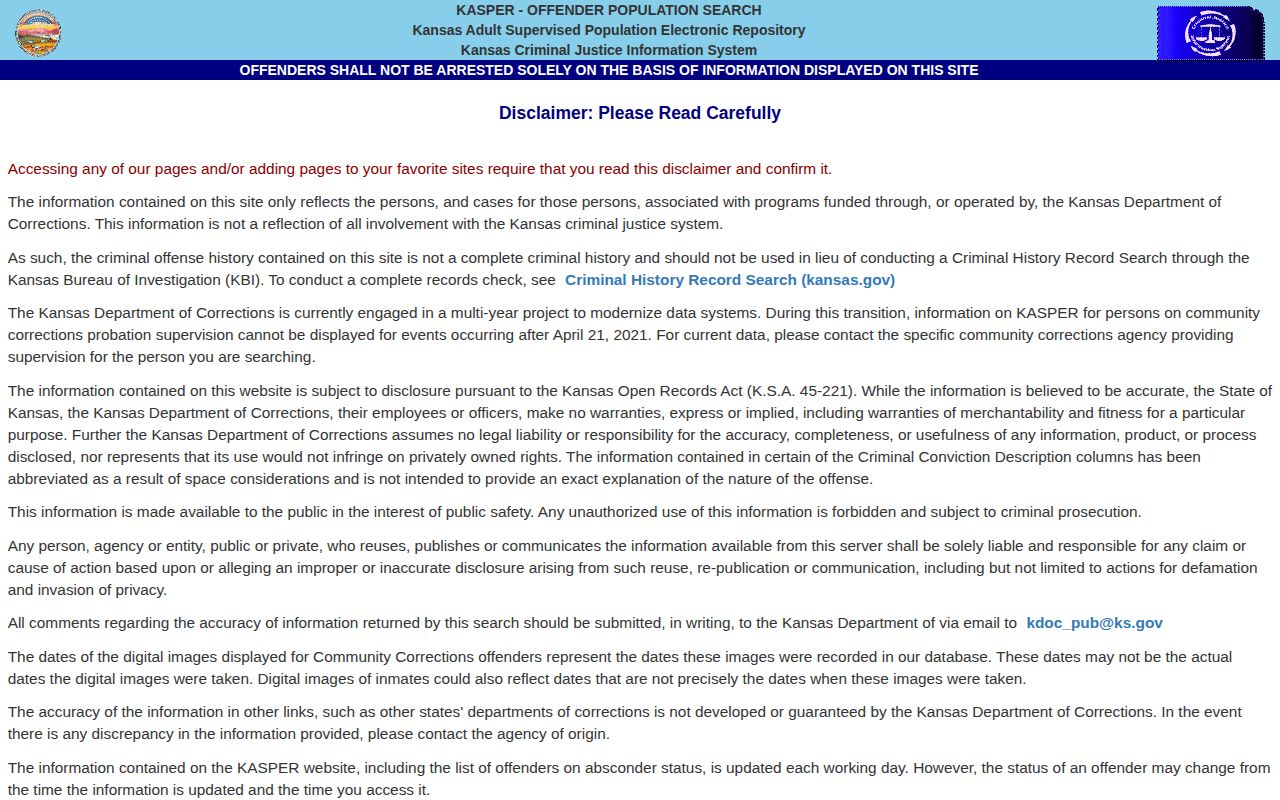
KDOC says KASPER is updated on working days. A weekend release or recent transfer can therefore produce visible lag. A county-jail custody change may never appear there unless the person is transferred into KDOC authority. If the live Wabaunsee roster no longer shows the person, do not substitute a KASPER non-result for confirmation. Call the sheriff, check the court, or request the transaction.
How Kansas Computes a Projected Prison Release Date
A KDOC anticipated date begins with the controlling sentence structure. Kansas distinguishes older indeterminate sentences, determinate sentences, off-grid terms, mandatory minimums, and other categories. Jail credit, concurrency or consecutiveness, and the governing offense date can materially change the calculation. Good-time credit is only one component.
K.S.A. 21-6821 governs good-time credits for many determinate sentences. For crimes committed on or after July 1, 1993, the statute uses different maximum categories. Certain severity levels can earn up to 15 percent of the prison portion, while qualifying lower-severity categories can earn up to 20 percent. Credits are earned according to KDOC rules and can be withheld or forfeited. Program credit may also matter where authorized. The statutory category must be identified before applying a percentage.
For older indeterminate cases, parole eligibility is not the same as a release date. K.S.A. 22-3717 ties eligibility to the applicable minimum and good time, but an eligible person may still need a Prisoner Review Board suitability decision. A Board outcome of “continue” postpones the decision; “pass” denies parole for a stated period. Neither outcome is release. Conditional release and maximum sentence have separate meanings under the older structure.
The Board’s official parole process page explains parole outcomes and release categories.

Many determinate sentences for crimes committed on or after July 1, 1993 move to mandatory postrelease supervision after the prison portion. The anticipated prison-release date therefore may mark a change from prison to supervision, not the end of the sentence. Confirm the later status through KASPER and the assigned parole office.
Does Kansas’s 85 Percent Rule Set a Wabaunsee Release Date?
Not by itself. The phrase “85 percent rule” is shorthand for the category in which maximum good time is 15 percent. It is not a universal release-date formula. K.S.A. 21-6821 also includes qualifying 20 percent categories, while off-grid crimes, mandatory terms, older indeterminate sentences, and other statutory structures can work differently. Even within a 15 percent category, the maximum credit should not be assumed to have been earned.
This distinction is especially important for a Wabaunsee county-jail sentence. The research found no published local formula that authorizes copying KDOC’s prison good-time percentages onto a county-jail term. A jail sentence may involve court-awarded jail credit and other case-specific calculations. The sentencing order, court docket, and sheriff’s records are the proper local sources. If a later state sentence is imposed, KDOC computes the state portion under the rules that apply to that sentence.
A quick percentage calculation can therefore misstate both the date and the kind of event. The reliable method is to read the official anticipated field, identify the sentence category, and ask the responsible computation office about a discrepancy.
What Changes a Wabaunsee County Projected Release Date?
| Factor | Possible effect | Record to check |
|---|---|---|
| Good time earned, withheld, or forfeited | Moves the calculated prison date within the governing statutory limit. | KDOC sentence computation and disciplinary record. |
| Program credit | May adjust the date where the sentence and KDOC rules authorize it. | KDOC computation record. |
| Corrected jail credit | Changes credit for qualifying time already spent in custody. | Court order and computation record. |
| Amended, concurrent, or consecutive sentence | Changes which term controls and how terms combine. | Judgment, later court order, and KDOC calculation. |
| Disciplinary finding | Can reduce or forfeit earned credit under applicable rules. | KDOC disciplinary and sentence records. |
| Appeal or other judicial relief | May alter or vacate a sentence. | Appellate and district-court dockets. |
| Detainer or another jurisdiction’s hold | Can change the practical destination even when the sentence date arrives. | Holding agency and receiving agency records. |
| Release-plan issue | May affect the transition process without rewriting the underlying sentence. | KDOC and supervision records. |
Do not assign every delay to a detainer or disciplinary action. Those are possibilities only when the record supports them. Likewise, disappearance from the Wabaunsee roster cannot reveal whether the person bonded out, completed a sentence, transferred, or was returned to an out-of-county authority.
County Jail Dates Need Wabaunsee Release Records
The Wabaunsee Sheriff operates the county detention center and is the likely custodian of the booking-specific release transaction. A focused request should identify the full name, booking number, and approximate booking date, then ask for the existing release sheet or transaction showing the completed release date and time, release type or transaction code, releasing authority, destination or transfer agency, and any existing code legend.
Kansas open-records procedure allows an agency to provide the records, state when they will be provided, or explain why they cannot be provided within three business days. That is a response deadline, not a promise of complete production within three days. An agency need only provide existing records and does not have to create a custom projected-date calculation.
For a court-authorized release, use the Wabaunsee District Court docket to understand the legal basis. A bond order can precede actual processing. A sentence of time served may not contain the door time. A dismissal in one case does not eliminate another hold. Pairing the order with the sheriff transaction resolves these different questions.
Confirm an Actual Wabaunsee County Release
After the projected day arrives, return to the source. For the county jail, check whether the person remains on the live roster, ask the sheriff about the booking, and use the transaction for exact proof. Kansas VINE can provide custody-change notification only if Wabaunsee County or the actual holding agency participates in the live service. A VINE “released” status means that contributing jail reported a custody change; it does not establish dismissal, destination, or final sentence discharge.
For state custody, check KASPER after allowing for working-day updates. A supervision level or parole-office field can show that the person left prison but remains under KDOC authority. A discharge status is different. If the person entered another county, federal, or immigration custody, follow that receiving authority rather than continuing to search the old roster.
The VINELink Release Check explains the county-jail notification path, while Parole / Probation explains how to verify continuing Kansas supervision. Together with the court and custodian record, those sources separate a planned date, an actual exit, and the end of a sentence.