
Parole vs Probation in Wabaunsee County
“Released” describes a custody event, not necessarily a supervision category. Kansas uses several legally distinct forms of community supervision. The sentence, offense date, judgment, and supervising authority control the label. Probation is generally imposed by a court as a community disposition. Parole applies mainly to eligible people serving older indeterminate or specified sentences and involves a Kansas Prisoner Review Board suitability decision. Many determinate prison sentences for crimes committed on or after July 1, 1993 lead to mandatory postrelease supervision after the prison portion, rather than discretionary parole.
| Status | How it begins | Best verification |
|---|---|---|
| Probation | A sentencing court orders community supervision, sometimes instead of incarceration. | Sentencing order, later docket entries, and the identified supervision agency. |
| Parole | The Prisoner Review Board finds an eligible person suitable for conditional release. | KASPER, the written Board decision, and the assigned parole office. |
| Mandatory postrelease | A determinate sentence moves from its prison portion to a required supervision term. | KASPER supervision fields, sentence documents, and KDOC. |
| Conditional release | An older indeterminate sentence reaches a statutory point, ordinarily tied to one-half of the maximum if good time has not been lost. | KDOC and Prisoner Review Board records. |
| Discharge | The sentence and supervision authority end, either at maximum sentence or through an authorized early discharge. | KASPER status and an official discharge record or certificate. |
How to Verify Wabaunsee County Post-Release Supervision
Use identifiers, not a name alone. The Kansas Adult Supervised Population Electronic Repository, commonly called KASPER, is the first public check for someone connected with the Kansas Department of Corrections. A result may show supervision level and a parole-office field, which can establish that a person is outside prison but still under KDOC authority. KASPER updates on working days, so a recent transition may not appear immediately.
- Search KASPER using the KDOC number when available. If searching by name, compare age and other identifiers before accepting a match.
- Read the custody or supervision level and the office named on the individual record. Do not infer “discharged” merely because the location is no longer a prison.
- If KASPER names an office, contact that office. The record-specific assignment controls if it differs from the general county directory.
- For probation, locate the Wabaunsee criminal case and review the sentencing order and later docket entries. The court record can identify the sentence and later modification or revocation.
- Resolve stale or missing information with the actual supervision agency. A court clerk can provide access to filed records, but should not be asked to interpret the legal effect of an order.
KDOC warns that current Community Corrections probation events after April 21, 2021 may be absent while systems are modernized. A blank or stale KASPER result therefore cannot settle every probation question. For a county probation case, the docket and sentencing order are especially important. The VINELink Release Check serves contributing county-jail custody notifications, not ongoing KDOC parole or probation status.
Wabaunsee County Parole Records Route Through Topeka
KDOC’s official directory assigns Wabaunsee County to the Topeka Parole Office. The same office serves Pottawatomie, Jackson, Osage, and Shawnee counties. This is a regional state-supervision assignment, not a statement that every released Wabaunsee detainee is on parole. Always check the person’s record first.
2029 SW Western Avenue
Topeka, KS 66604
785-296-5515
The official KDOC parole-office directory is the source for the assignment.
Use the office number to resolve a recent working-day update lag or confirm which office is responsible. Do not publish an officer’s name, private schedule, or reporting details. Those operational facts belong between the supervised person and KDOC.
Kansas Parole Hearings and Wabaunsee County Records
The Kansas Prisoner Review Board handles parole suitability for eligible indeterminate cases, establishes postrelease conditions in the determinate structure, and handles revocation within its authority. Its public-comment sessions occur monthly, one month before the associated parole hearing. The upcoming-offender list can show a name, KDOC number, county of offense or commitment, case number, and Kansas offense code. That county is the conviction county, not necessarily the person’s home or planned return county.
Board terminology matters. “Parole” means the Board found the person suitable for release under conditions. “Continue” means a decision was postponed for more deliberation, votes, information, or evaluation. “Pass” means parole was denied for a stated period. Eligibility, a calendar listing, a public-comment session, a continue, and a pass are not proof that someone was physically released.
The Board publishes an official public-comment calendar and an upcoming-offender list, but the research found no official person-by-person public decisions database. The person receives the written decision. Later KASPER information can corroborate that a custody transition happened, but it is not a substitute for the Board’s written decision.
Does a Wabaunsee County Warrant Mean Parole Absconding?
No. An absconder indication means a person is alleged to be unavailable to supervision. It does not mean the sentence is discharged, and it should not be treated as a new conviction. A county warrant can arise for other reasons, including a later failure to appear. Wabaunsee County’s searchable warrant page is useful as a separate local cross-check, but it is not the Kansas parole absconder system and does not establish when or whether a person was previously released.
The official Wabaunsee County warrant search publishes fields that can include name, warrant number, charges, bond, date, age, sex, and race.
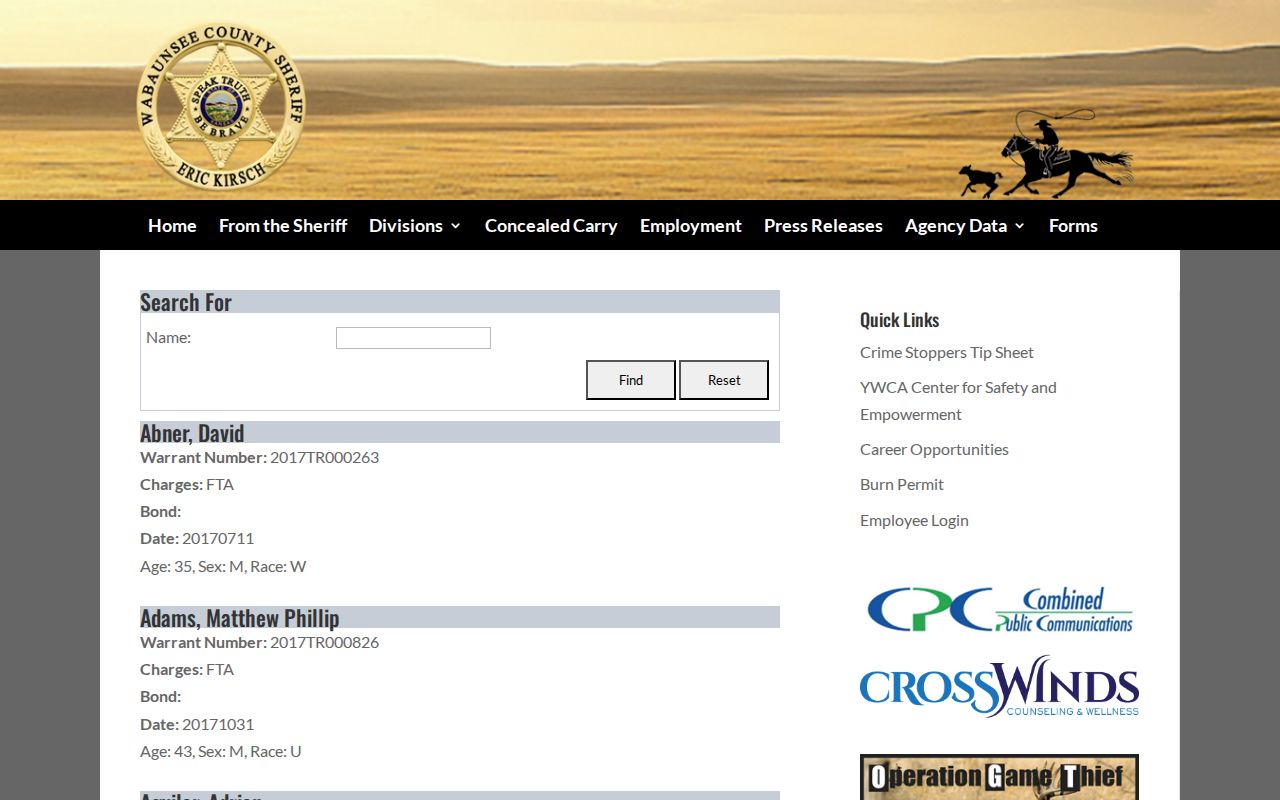
Match identifiers carefully and contact the issuing agency or court for the warrant’s current status. Never attempt to detain someone. KDOC likewise instructs the public not to attempt an arrest; immediate danger belongs with 911.
Wabaunsee County Supervision Conditions and Revocation
Conditions vary by sentence and authority. They can require reporting, approved residence, treatment, payment, travel permission, or compliance with other written directions, but a public page should not guess at a particular person’s conditions. The controlling sources are the sentencing order, Board decision, and supervision documents. A violation allegation does not itself prove revocation. Revocation requires the applicable legal process and can produce a return to custody, modified conditions, or another result.
A person who leaves the Wabaunsee County Detention Center may also be transferred rather than released to the community. The current roster includes people connected to other counties, and a roster disappearance can mean return to another jurisdiction. Check the receiving jail, KASPER after state intake, and the court record before describing the event as parole, probation, or community release.
The Kansas offender registry is also separate. A public registry entry concerns a statutory registration duty for a qualifying sex, violent, or drug offender. It is not a universal post-release list, parole roster, or custody indicator. Absence from that registry proves none of those statuses.
How Wabaunsee County Post-Release Supervision Ends
Successful completion is different from the day someone walks out of prison or jail. The Prisoner Review Board can discharge a successful releasee on a parole officer’s recommendation when the law gives it that authority. An older indeterminate sentence may continue through conditional release until maximum sentence or an authorized early discharge. Maximum release means the sentence has been satisfied and no Board or KDOC supervision remains; the Board issues a maximum sentence discharge certificate.
To document the end of supervision, compare KASPER with the official discharge record. A focused KDOC records request can ask for the release or discharge entry, movement record, or maximum sentence discharge certificate using the person’s full name and KDOC number. If the issue is how a date was computed, the KDOC Sentence Computation Unit is the more suitable route. The county court record remains important for probation discharge and later orders.
The Wabaunsee County released-inmate search guide explains how jail release transactions and court records document the physical custody event. Keep that date separate from the later supervision-end date. Doing so prevents a current community placement from being mislabeled as an unconditional discharge.